
Modern and traditional bathroom cabinets can both work well, but the better choice depends on the bathroom’s size, overall home style, storage needs, and how much visual detail you want. We usually recommend choosing the cabinet style after considering the vanity size, countertop material, hardware, and amount of available storage together.
For homeowners comparing bathroom cabinet doors in Naperville, IL, the decision often comes down to one question: do you want the bathroom to feel clean and minimal, or warmer and more detailed? Both approaches can look current when the materials, proportions, and finishes are selected carefully.
We see this decision frequently at Redwood Cabinets of Chicago because homeowners are often updating an older bathroom without changing the entire room. A new vanity, countertop, hardware, and backsplash can make a significant difference without requiring a complete bathroom reconstruction.

What is the difference between modern and traditional bathroom cabinets?
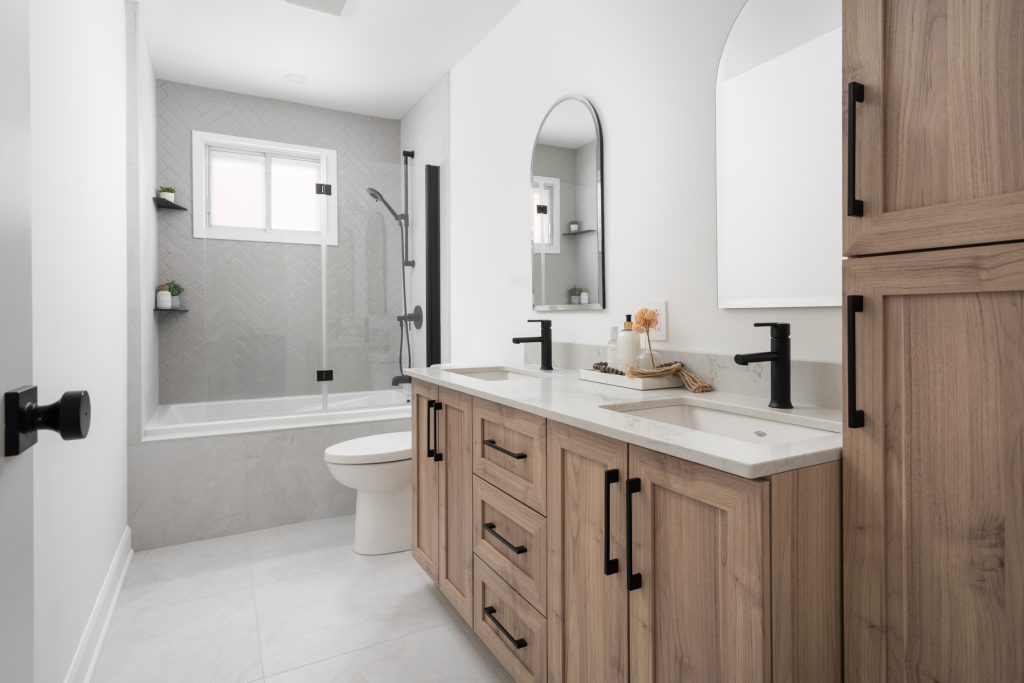
Modern cabinets typically have flat or very simple door fronts, while traditional cabinets use more decorative profiles, such as raised panels, recessed panels, or detailed trim. The difference is primarily visual, but it also affects how the vanity works with other materials in the room.
Modern cabinetry tends to emphasize clean lines and uninterrupted surfaces. Traditional cabinetry introduces more depth and visual detail through door profiles, molding, decorative edges, and sometimes furniture-style legs.
| Feature | Modern Cabinets | Traditional Cabinets |
|---|---|---|
| Door style | Flat panel or simple slab | Raised or recessed panel |
| Visual character | Minimal and clean | Detailed and classic |
| Hardware | Simple pulls or knobs | Decorative knobs or pulls |
| Best pairing | Quartz, simple tile | Marble, granite, decorative tile |
| Overall feel | Contemporary | Warm and classic |
| Maintenance | Generally easy | More detailed surfaces to clean |
Neither option is automatically better. We focus on whether the cabinet style fits the room instead of choosing based only on what is currently popular.
Are modern bathroom cabinets better for small bathrooms?
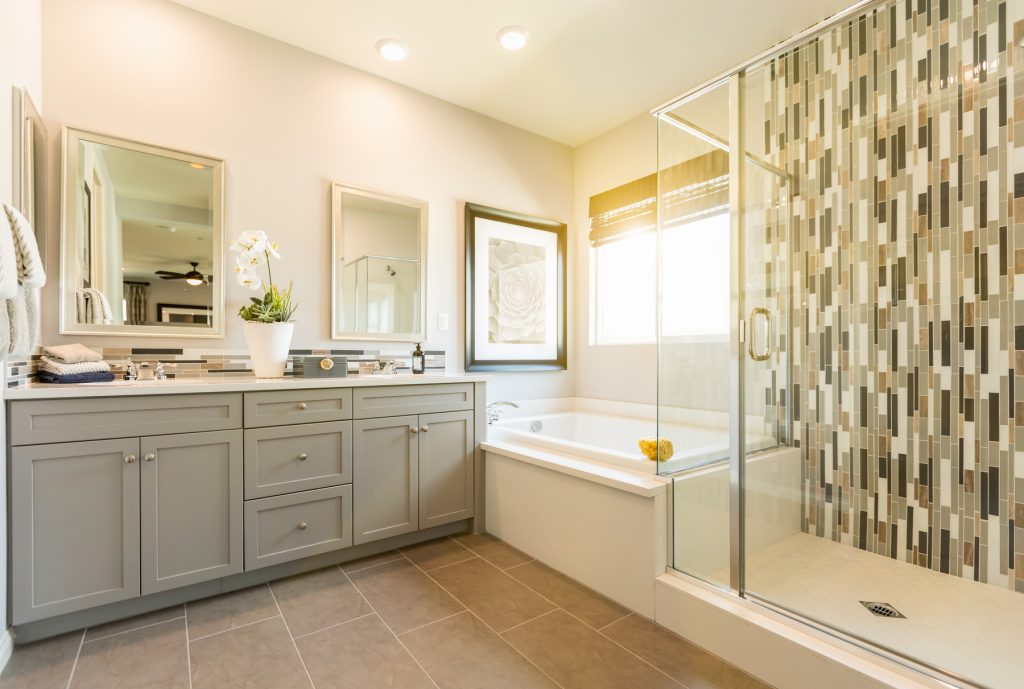
Yes, modern cabinets often work particularly well in smaller bathrooms because their simpler fronts can make the vanity area feel less visually busy. Flat-panel doors and streamlined hardware can create a cleaner appearance when floor space is limited.
For a compact bathroom, we may recommend a wall-mounted vanity or a simple rectangular cabinet design. Keeping the cabinet profile uncomplicated can make the room feel more open without physically increasing its size.
This is especially useful when selecting bathroom cabinet doors in Naperville, IL for bathrooms where every visual detail matters. A small vanity with heavily decorative doors, thick molding, and ornate hardware can sometimes dominate the room.
Traditional cabinets can still work in a small bathroom, however. A light finish, appropriately sized vanity, and restrained hardware can keep the design balanced.
When do traditional bathroom cabinets make more sense?
Traditional cabinets make more sense when the bathroom already contains classic architectural details or when homeowners want the vanity to feel like furniture rather than a built-in storage unit. Raised-panel doors, decorative hardware, and molding can work particularly well with traditional homes.
We often see traditional cabinets paired with marble countertops, granite, framed mirrors, and patterned backsplash tile. These materials reinforce the visual depth of the cabinet design instead of competing with it.
A traditional vanity can also be a good choice when the bathroom connects visually to a traditional kitchen or other rooms in the home. Consistency between spaces can make the entire house feel more intentional.
Which cabinet style is easier to maintain?
Modern cabinets are generally easier to wipe down because flat doors have fewer grooves and decorative surfaces where dust and residue can collect. Traditional cabinets can require a little more attention around recessed panels, molding, and detailed edges.
That does not mean traditional cabinets are difficult to maintain. It simply means the surface has more areas where dust, toothpaste, hairspray, and moisture can accumulate.
For a busy household, we often suggest considering maintenance before choosing the door profile. If the bathroom is used heavily every day, a simple cabinet door can save a little cleaning time.
Which materials are best for bathroom cabinets?
Plywood and birch are practical options for bathroom cabinetry, but the right material depends on the cabinet component and the design requirements. Bathroom cabinetry should be able to handle regular humidity, cleaning, and everyday use.
Plywood is commonly used for cabinet boxes because of its strength and dimensional stability. Birch can be used for doors, drawer fronts, and other visible components, depending on the desired finish.
We also pay attention to the finish itself. A properly applied finish helps protect the cabinet surface from moisture and routine bathroom use.
For homeowners comparing bathroom cabinet doors in Naperville, IL, we recommend evaluating the entire cabinet construction rather than judging quality by the door appearance alone.
Should the bathroom vanity match the kitchen cabinets?
Not necessarily, but the two spaces should usually feel compatible. Matching the exact cabinet style throughout the house is not required, especially when the bathroom has a different architectural purpose.
For example, a home may have traditional kitchen cabinets but a modern bathroom vanity. Using similar wood tones, hardware finishes, or countertop colors can connect the spaces without making them identical.
The opposite can also work. A modern kitchen and traditional bathroom can coexist successfully when each room has its own identity and the overall finishes remain coordinated.
How should countertops influence the cabinet choice?
The countertop should be considered before finalizing the cabinet style because the two surfaces occupy a large portion of the vanity area. Quartz, granite, and marble each create different visual relationships with cabinet doors.
A simple modern cabinet can allow a heavily veined marble countertop to become the main feature. Conversely, a traditional vanity with a detailed door profile may pair better with a quieter quartz or granite pattern.
| Countertop | Works Well With | Practical Consideration |
|---|---|---|
| Quartz | Modern or traditional | Low-maintenance option |
| Granite | Traditional or transitional | Natural variation |
| Marble | Traditional or modern | Requires more care |
| Light quartz | Modern | Creates a clean appearance |
| Dark granite | Traditional | Adds contrast |
The countertop also affects fabrication and installation. We generally finalize cabinet dimensions before the countertop template so the finished vanity fits correctly.
How much do bathroom cabinets cost?
Bathroom cabinet pricing depends on vanity size, construction, materials, door style, hardware, and installation requirements. Around $300 per linear foot can be used as a general starting reference for some cabinetry projects, but the actual price can be higher or lower depending on the project.
The largest cost factors include:
- Cabinet dimensions
- Custom sizing
- Door construction
- Plywood or other box materials
- Birch or wood door components
- Hardware
- Drawer configuration
- Installation
- Countertop selection
When comparing bathroom cabinet doors in Naperville, IL, we recommend looking at the complete project price rather than comparing individual doors or cabinet boxes.
A low cabinet price may not include installation, hardware, countertop fabrication, sink cutouts, or other necessary work.
How long does a bathroom cabinet project take?
A typical cabinet project can take several weeks, with many projects falling into a 3-5 week range from finalized design through installation. The exact schedule depends on cabinet availability, fabrication requirements, measurements, material selection, and the complexity of the bathroom.
A typical process includes:
- Measure the bathroom and existing vanity area.
- Review storage requirements.
- Select modern or traditional cabinet style.
- Choose materials and finish.
- Finalize cabinet dimensions.
- Fabricate or prepare the cabinetry.
- Remove the existing vanity if necessary.
- Install the new cabinets.
- Complete countertop and backsplash work.
- Install hardware and make final adjustments.
Accurate measurements are particularly important in bathrooms because walls, plumbing, mirrors, and doors can leave very little room for error.
Can modern and traditional styles be mixed?
Yes, a transitional design can combine modern and traditional elements successfully. This is often the best approach for homeowners who like the warmth of traditional cabinetry but do not want the bathroom to feel overly formal.
For example, we might combine a recessed-panel cabinet with simple hardware, a quartz countertop, and clean backsplash tile. The result has more character than a completely minimalist vanity but avoids excessive ornamentation.
This approach is also useful when selecting bathroom cabinet doors in Naperville, IL for homes that already contain a mixture of architectural styles.
Which cabinet style should you choose?
Modern cabinets are usually the better choice when you want clean lines, easy maintenance, and a simple contemporary appearance. Traditional cabinets are usually the better choice when you want more visual detail, furniture-like character, and a stronger connection to classic interior design.
We recommend asking these questions before making the final decision:
- Is the bathroom small or spacious?
- Is the rest of the home modern, traditional, or transitional?
- How much storage do you need?
- How much time do you want to spend cleaning detailed surfaces?
- Are you choosing marble, quartz, or granite?
- Will the vanity be a major design feature?
- Do you want the bathroom to match nearby rooms?
There is no universal winner. The best cabinet style is the one that fits the room’s proportions, storage requirements, materials, and overall design.
FAQ: Modern vs Traditional Bathroom Cabinets
Are modern bathroom cabinets more popular?
Modern and transitional styles are both widely used. Popularity varies by home style, bathroom size, and homeowner preference.
Are traditional cabinets outdated?
No. Traditional cabinets remain a practical choice, particularly in homes with classic architectural details. The finish and hardware can make the style feel current.
Are flat-panel cabinets easier to clean?
Generally, yes. Flat-panel doors have fewer grooves and decorative edges where dust and residue can collect.
Is plywood good for bathroom cabinets?
Yes. Plywood is commonly used for cabinet boxes because it provides good strength and stability.
Can I use marble with modern cabinets?
Yes. Modern flat-panel cabinets can work very well with marble, especially when the marble has prominent veining and the rest of the bathroom is kept simple.
How long does bathroom cabinet installation take?
Installation itself may take a relatively short period, but the complete project can take approximately 3-5 weeks when design, fabrication, delivery, and installation are included.
Should bathroom cabinets match kitchen cabinets?
They do not have to match exactly. Coordinating finishes, hardware, colors, or materials can create a connection between the rooms without making them identical.
Bathroom Cabinet Services in Chicago, IL
At Redwood Cabinets of Chicago, we work with homeowners in Chicago, IL and surrounding communities, including Naperville, on bathroom cabinet design, fabrication, and installation. We help coordinate cabinetry with countertops, backsplash materials, hardware, and the practical storage needs of each bathroom.
For homeowners comparing bathroom cabinet doors in Naperville, IL, we look beyond the door style and consider construction, dimensions, materials, maintenance, and how the vanity will function every day. Whether the right choice is modern, traditional, or transitional, our goal is to build a cabinet solution that fits the actual space.